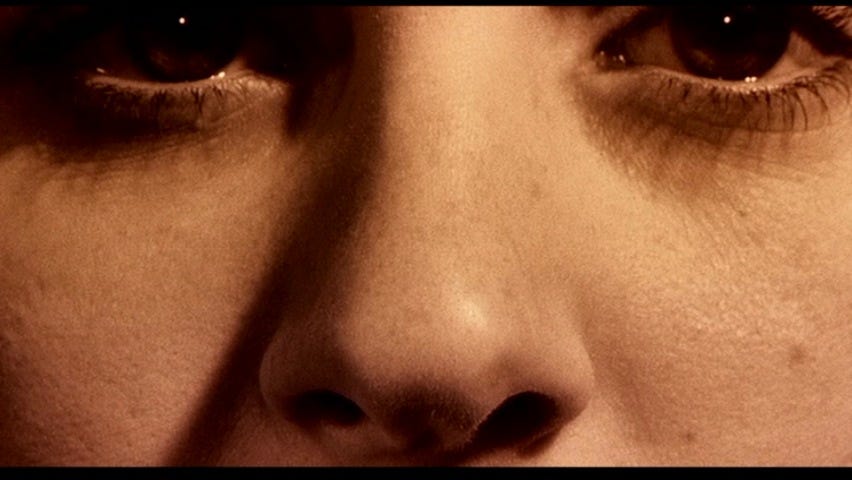
The Female Gaze Reversed: Power and Objectification in Vertigo
Alfred Hitchcock's "Vertigo" (1958) is often discussed in terms of its male gaze, with James Stewart's Scottie Ferguson obsessively watching, following, and attempting to recreate Kim Novak's Madeleine/Judy. However, a closer examination reveals a more complex dynamic at work. The film systematically subverts traditional patterns of looking and being looked at, ultimately turning the tables on its male protagonist and making him the true object of observation and manipulation.
From the film's opening sequence, Scottie is established as someone who is himself watched and observed. The rooftop chase ends with him hanging from a gutter, watched helplessly by his fellow officer who then falls to his death. This traumatic moment of being watched while vulnerable sets the tone for the rest of the film, where Scottie's role as observer is consistently undermined by his own position as the object of others' gazes.
When Scottie begins following Madeleine, he believes he is in control as the observer. The camera adopts his point of view as he tracks her through San Francisco's streets, museums, and churches. Yet this apparent control is illusory. Madeleine/Judy is actually orchestrating every moment of his observation, leading him precisely where Gavin Elster's plot requires him to go. Her seemingly random wanderings are carefully choreographed performances designed to be watched. In this sense, she holds the true power in these scenes, manipulating Scottie's gaze while appearing to be its passive object.
The film's famous scene at Ernie's Restaurant exemplifies this complex dynamic. When Scottie first sees Madeleine, the camera adopts his perspective, slowly revealing her profile in what appears to be a classic example of the male gaze objectifying a female subject. However, this moment is later revealed to be entirely staged. Judy, performing as Madeleine, has deliberately positioned herself to be seen in exactly this way. The seemingly spontaneous moment of male observation is actually a carefully constructed performance by its female subject.
This pattern continues throughout the first half of the film. Every instance of Scottie watching Madeleine is, in fact, a moment of him being manipulated by her performance. His gaze, rather than conferring power, makes him vulnerable to deception. The more intently he watches, the more thoroughly he is fooled. His position as observer paradoxically makes him the victim of his own observation.
The power dynamics become even more complex in the film's second half, after Madeleine's apparent death and Scottie's discovery of Judy. Here, the male gaze becomes explicitly controlling and destructive, as Scottie attempts to remake Judy in Madeleine's image. Yet even in these scenes, where Scottie appears to hold all the power, there are layers of complexity to who is watching whom.
Judy's awareness of her dual identity makes her a more knowing observer of Scottie than he is of her. She watches him watching her, understanding the full truth of the situation while he remains obsessed with an illusion. Her gaze is more penetrating than his because it sees both his delusion and her own complicity in creating it. Even as she submits to his controlling gaze, she maintains a level of awareness that he lacks.
The scene of Judy's transformation back into Madeleine is particularly rich in its exploration of looking and being looked at. As Scottie forces Judy to recreate herself as Madeleine, the camera shows us both his obsessive gaze and her awareness of being watched. The green light from the hotel's neon sign creates an ghostly atmosphere that emphasizes the artificial nature of this recreation, suggesting that Scottie's controlling gaze is focused on an illusion rather than reality.
When Judy finally emerges fully transformed as Madeleine, the moment of Scottie's apparent triumph is undercut by our awareness of its artificiality. His gaze has not captured or created truth but has instead further entangled him in a web of deception. The power he thinks he holds through looking is revealed as another form of vulnerability.
The film's climactic tower scene brings these themes to their tragic conclusion. Scottie's determination to force Judy to reenact the scene of Madeleine's death represents the ultimate attempt to control through observation. Yet this final exercise of the male gaze leads not to mastery but to catastrophe. Scottie's insistence on seeing the truth destroys both the object of his gaze and his own illusions.
Throughout "Vertigo," the traditional power dynamics of observation are consistently subverted. While Scottie appears to be the one doing the watching, he is actually the one being watched, manipulated, and controlled through his own act of looking. His gaze, rather than conferring power, makes him vulnerable to manipulation and ultimately leads to his downfall.
This reversal of the traditional gender dynamics of observation makes "Vertigo" a surprisingly modern film in its treatment of gender and power. While it presents a male protagonist apparently in control through his ability to watch and follow women, it ultimately reveals this apparent control as illusory. The real power in the film lies not with the male observer but with the female subject who manipulates his gaze.
The film's treatment of observation and power anticipates many contemporary discussions about gender and looking in cinema. Its sophisticated understanding of how the act of looking can make the observer vulnerable rather than powerful, and how the observed can maintain agency through performance and manipulation, feels remarkably current.
Moreover, the film suggests that the very act of obsessive observation can be self-defeating. The more intently Scottie tries to capture and control through his gaze, the more thoroughly he is deceived and manipulated. His tragedy stems not from insufficient observation but from too much looking, from a belief that seeing equals understanding and that watching equals control.
In this way, "Vertigo" offers a critique of the male gaze even as it employs it. The film suggests that the power dynamics of observation are more complex than simple models of male activity and female passivity would suggest. Through its intricate plot and sophisticated visual style, it creates a world where looking is never simple and where the observer may be more vulnerable than the observed. This complexity makes "Vertigo" not just a masterpiece of suspense but a sophisticated exploration of gender, power, and the act of looking itself.


A fresh, thought-provoking look (pardon the pun) at this inexhaustible masterpiece.